
Skip to searchSkip to main content
  • _csp_www_linkedin_com_in_vazemandar_
  • Process Excellence & ISO Readiness

Build structured, scalable, and audit-ready business processes

At Trans4m Business Consulting, we design practical, ISO-aligned processes that bring structure, clarity, and consistency to your business. Whether you're improving daily operations or preparing for future certification, we help you move from informal ways of working to documented, managed, and audit-ready systems.


Through our All About Processes and ISO Readiness offerings, we build the foundation for evidence-based compliance, stronger governance, and scalable growth. From ISO 9001, 14001, 45001, and 27001 to integrated management systems, we make compliance practical and achievable.


Processes are not just back-office details. They are the engine of growth, control, and scale. Combined with our Fractional PMO support, we ensure systems are not only designed, but also embedded, governed, and executed with confidence.

Contact Us
Book an appointment

4 Phased Approach

Misconceptions vs Actuals

Process Excellence
ISO Readiness
Process Excellence

What most people think (misconceptions) ...

❌ Just paperwork for compliance

❌ Time-consuming documentation exercise

❌ Creates bureaucracy and rigidity

❌ Something consultants produce & forget

What process documentation actually is ...

✔ Clear map of how work flows

✔ Reduce dependency on individuals

✔ Improces consistency & accountability

✔ Foundation for scalable operations

ISO Readiness

What most people think ISO is ..

❌ 500 Pages f boring documentation

❌ Only applicable for big corporates

❌ Expensive Consultants & endless audits

What ISO actually is ..

✔ Clear Processes

✔ Consistent service delivery

✔ A business that runs even when owner is on holiday

Includes ...

Step 1: Process Maturity Assessment

We start by evaluating how mature your business processes really are—across structure, documentation, ownership, standardisation, and performance tracking. This assessment helps identify strengths, risks, and improvement opportunities using frameworks tailored to your business. The result? A detailed maturity scorecard and actionable roadmap that supports sustainable growth, better delegation, and operational resilience.
​We cover 7 areas while evaluating the process maturity:
​🔹Process Design & Documentation: Are processes documented and accessible?
🔹Governance & Ownership: Who is accountable for each process?
🔹Measurement & Performance: Are KPIs defined and tracked?
🔹Standardisation & Consistency: Are processes followed across teams/sites?
🔹Technology & Automation: Are IT systems and automation supporting efficiency?
🔹Continuous Improvement: Are there regular reviews and innovations?
🔹Compliance & Risk: Are compliance requirements and risks managed effectively?

Step 2: Process Flows

Using interviews, document reviews, and team workshops, we capture how work is actually done today—not just how it’s supposed to be done. We create visual, role-based swimlane maps for your current (as-is) and improved (to-be) processes, highlighting gaps, bottlenecks, handoffs, and decision points. These maps help teams align, identify improvement areas, and communicate more clearly across departments.

Step 3: Process Documentation

We convert process knowledge into structured, user-friendly documentation that your team can actually use—SOPs, checklists, screen-by-screen walkthroughs, templates, and role guides. This ensures consistency, reduces onboarding time, and lowers dependency on key individuals. Each document is mapped to the process flow for easy reference and version control.

Step 4: Process Improvements & Automation

Process Improvements, including Automation, focus on streamlining workflows to remove inefficiencies, reduce errors, and improve speed. Using methods like Lean and DMAIC, we redesign processes for clarity and impact—then apply automation to repetitive tasks using low-code tools or integrations. This ensures you scale smarter, not just faster.

ISO 9001: 2015 QMS

Quality Management System

Ensures consistent delivery of products and services through clear, repeatable, and well-controlled business processes.

ISO 14001:2015 EMS

Environmental Management System

Helps organisations manage environmental impacts responsibly by embedding sustainability into everyday operations.

ISO 27001: 2022 ISMS

Information Security Management System

Protects sensitive information by controlling how data is accessed, used, and safeguarded across the business.

ISO 45001:2018 OHSMS

Occupational Health & Safety Management System

Creates safer workplaces by proactively managing risks and embedding safety into daily work practices.

Organisational Structure

Visualise your organisation clearly.
Create org charts and position descriptions so roles, responsibilities, and reporting lines are always clear.

Policy Management & Governance

Create structured policy workflows covering drafting, review, and approval.
Policies are linked to position descriptions for clear ownership and cross-referenced with process documentation to ensure alignment between policy and day-to-day operations.

Process Documentation & Role Alignment

Create process documents and visual maps that clearly show how work is done.
Each step is linked to roles in the organisational chart, ensuring clear ownership, accountability, and consistency across the business.

Operational Incident Management

Capture and manage process-related incidents.
When a process is triggered, incidents create workflows to record actions, steps taken, and outcomes for quality and compliance.

Post MIS Business As Usual Pathways

Post MIS BAU Pathways (2 options)


One-time Implementation

  • Higher MIS setup cost + handover to client
  • No ongoing consulting cost

⚠ Risk of losing focus and reverting to old ways


Managed Compliance Model

  • Low setup cost + monthly retainer
  • Monthly ongoing ISO compliance support
  • Continuous monitoring and improvements
  • Keeps processes active, compliant, and audit-ready
Certification Approach

Certification Approaches (2 options)

Go for Full Certfication

  • External audit by accredited body after 4-6 months of BAU Process Compliance


Stay ISO-Aligned without Certifocation

  • Adopt best practices and improve operations
  • Certify later when required (tenders/clients) 
  • Flexible and cost-effective approach
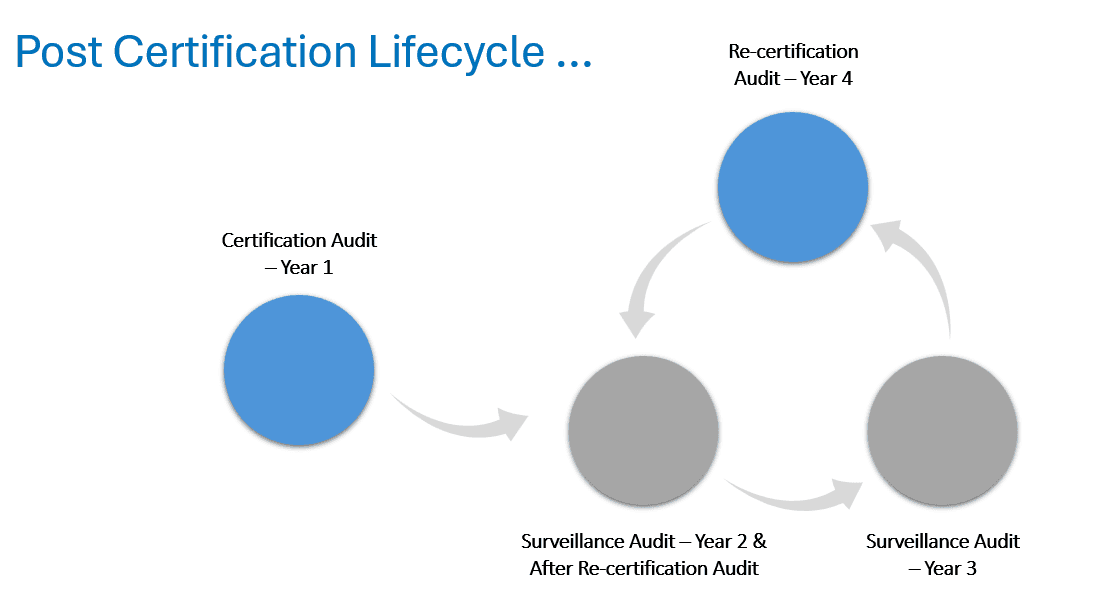
Post Certification Lifecycle

FAQs

What are ISO Aligned Processes?

ISO Aligned Processes are structured business processes designed in line with ISO standards such as ISO 9001, 14001, 45001, and 27001.
They bring consistency, governance, and operational clarity, forming the foundation for scalable growth and future certification.

What is the difference between ISO alignment and ISO certification?
  • ISO Alignment: Internal structuring of processes, policies, and controls
  • ISO Certification: External audit and formal recognition by a certification body

Alignment ensures your business is audit-ready, while certification is the final validation step.
What is an Integrated Management System (IMS)?

An Integrated Management System (IMS) combines multiple ISO standards—typically ISO 9001 (Quality), ISO 14001 (Environmental), and ISO 45001 (Health & Safety), into one unified system.
Since a large portion (40%) of requirements overlap, IMS reduces duplication and improves efficiency.

Which ISO standards are relevant for my business?

It depends on your industry and goals:

  • ISO 9001: Quality and operational consistency (suitable for all businesses)
  • ISO 14001: Environmental management (construction, manufacturing, logistics)
  • ISO 45001: Workplace health & safety (high-risk industries)
  • ISO 27001: Information security (IT, SaaS, finance, healthcare, professional services)

We help you identify the right combination based on your business needs.
Why should I implement ISO 9001, 14001, and 45001 together?

Implementing them as an IMS:

  • Reduces duplication of processes
  • Creates one unified system instead of multiple frameworks
  • Lowers implementation and maintenance effort
  • Improves governance across quality, safety, and environment
How is ISO 27001 different from other ISO standards?

ISO 27001 focuses on information security and is more complex due to:

  • Detailed risk assessments
  • Extensive documentation
  • Implementation of ~93 security controls

It is essential for businesses handling sensitive or confidential data.
How long does ISO implementation take?

Typical timelines:

  • ISO 9001 / IMS: 4–8 weeks
  • ISO 27001: 8–16 weeks

The timeline depends on business size, complexity, and current maturity.
Is ISO certification worth it for SMEs and startups?

Yes. ISO helps:

  • Build trust with clients and partners
  • Improve internal efficiency and scalability
  • Reduce reliance on key individuals
  • Increase chances of winning larger contracts
Will ISO certification help me grow my business?

Absolutely.

ISO helps:

  • Win government and corporate tenders
  • Build trust with clients and partners
  • Enable international expansion
  • Strengthen internal operations and scalability
What happens after implementation?

Two options:

Option 1: One-time setup

  • System handed over to your team
  • Lower cost
  • Risk of losing momentum over time

Option 2: Managed Compliance
  • Ongoing support and governance
  • Regular reviews and updates
  • Keeps your business audit-ready and compliant

Our Blogs

Loading...