

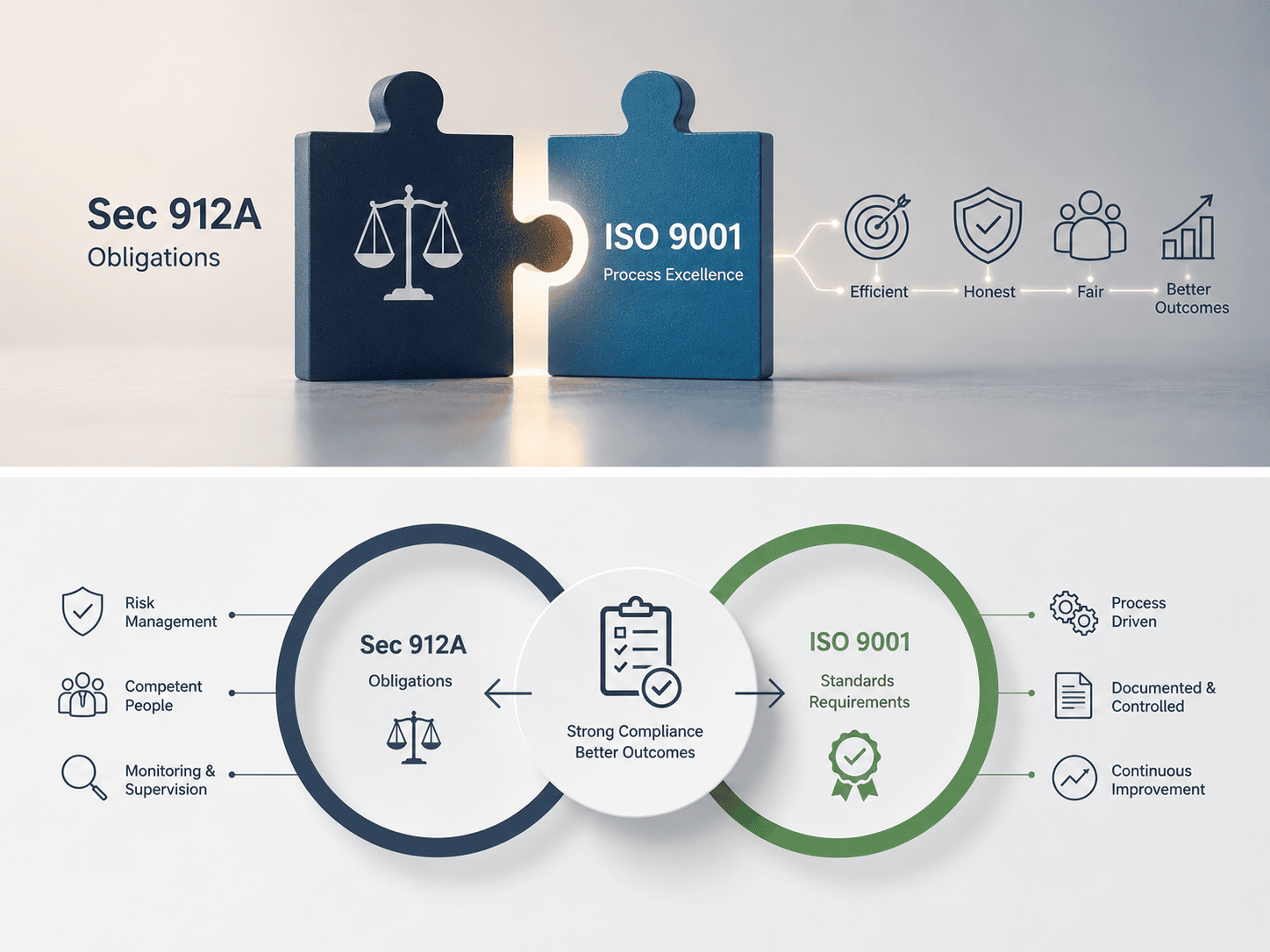
Understanding Section 912A Through an ISO 9001 Lens
Financial Services Licensees (AFSL holders) are familiar with Section 912A of the Corporations Act.
Most know the obligations. Many struggle with demonstrating them consistently.
That is where ISO 9001 becomes valuable.
ISO 9001 is not a financial services regulation. It is a globally recognised management system that helps businesses create repeatable, controlled and measurable processes.
When viewed through an AFSL compliance lens, ISO 9001 provides a practical framework for supporting Section 912A obligations.
What Does Section 912A Require?
Section 912A requires AFSL holders to:
🔹Provide services efficiently, honestly and fairly.
🔹Maintain adequate risk management systems.🔹Ensure representatives are adequately trained and competent.
🔹Maintain adequate resources.
🔹Comply with financial services laws.
🔹Monitor and supervise representatives.
🔹Have appropriate dispute resolution arrangements.
These obligations sound straightforward.
The challenge is proving they happen consistently.
The ISO Connection ...
ISO 9001 focuses on process discipline.
It requires organisations to define processes, assign responsibilities, manage risks, monitor performance and continually improve.
These principles align closely with what ASIC expects from AFSL holders.
Final Thought ...
Section 912A tells AFSL holders what they must achieve.
ISO 9001 provides a practical framework for how to achieve it.
Together, they create stronger governance, better customer outcomes and more sustainable compliance practices.
At Trans4m Business Consulting, we help AFSL holders align their operational processes with ISO 9001 principles, creating a structured pathway towards stronger compliance, operational excellence and business growth. The result is simple.
🔹Better processes.
🔹Better evidence.🔹Better compliance.
Learn more at ISO for AFSL Compliance