
ISO Standards Decoded: Which ISO Does Your Business Actually Need?
For many business owners, ISO feels confusing.
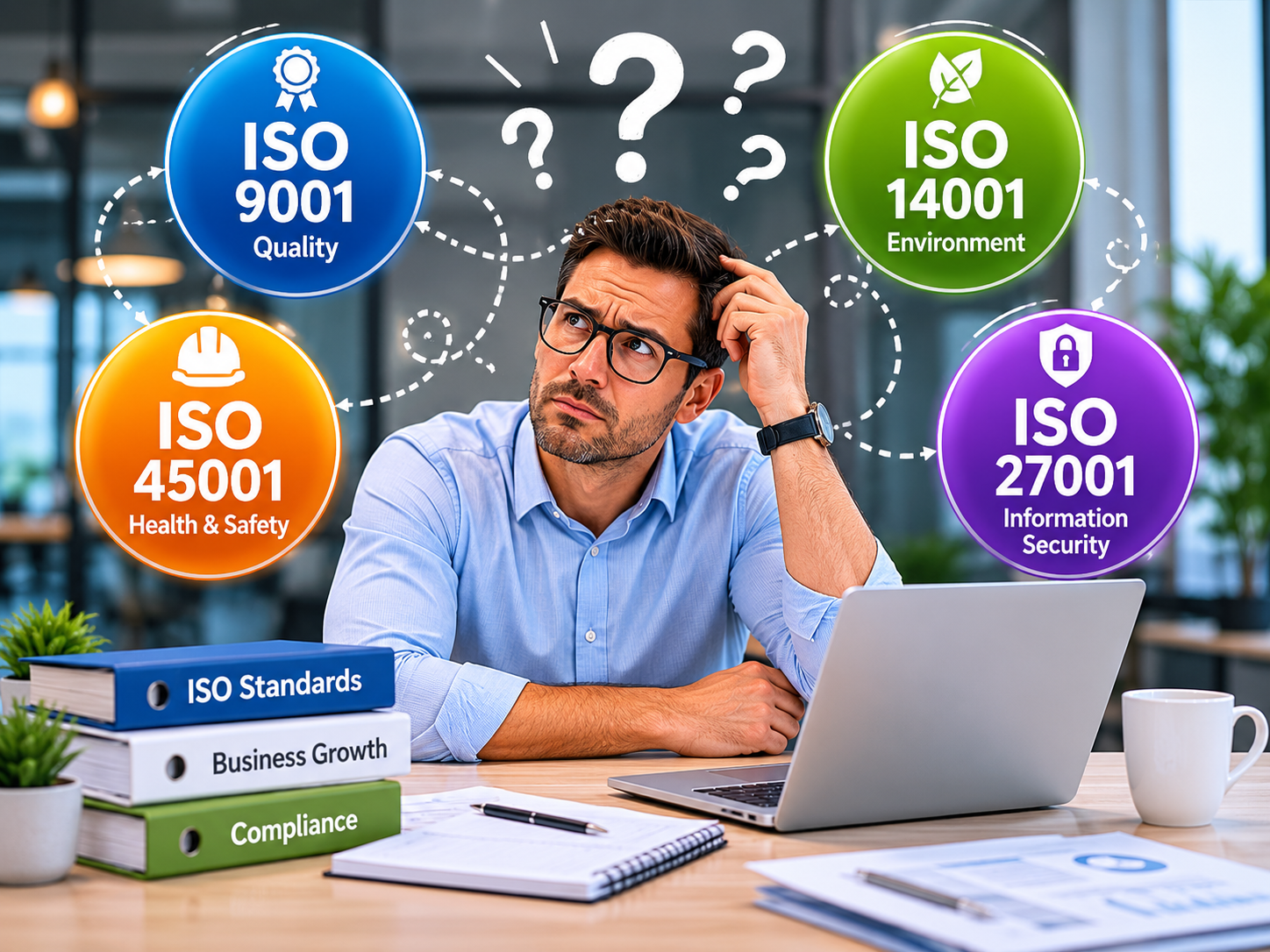
There are numbers everywhere — ISO 9001, ISO 14001, ISO 45001, ISO 27001 — and suddenly it sounds more like mathematics than business improvement.
But the truth is much simpler.
Each ISO standard focuses on strengthening a specific area of your business, and when combined correctly, they create a powerful operational framework that improves efficiency, reduces risks, and supports growth.
ISO Made Simple
ISO 9001 - Quality Management
Think of ISO 9001 as the foundation of operational excellence. It helps businesses:
🔹Improve consistency
🔹Deliver better customer experiences
🔹Reduce errors and rework
🔹Build scalable processes
🔹Strengthen governance
In simple terms: ISO 9001 helps businesses run better.
ISO 14001 – Environmental Management
ISO 14001 focuses on environmental responsibility and sustainability. It helps organisations:
🔹Reduce environmental impact
🔹Improve resource efficiency
🔹Manage waste better
🔹Strengthen ESG positioning
🔹Meet sustainability expectations from clients and regulators
This is becoming increasingly important as customers, governments, and investors place greater focus on sustainable business practices.
ISO 45001 – Health & Safety Management
SO 45001 focuses on workplace health and safety. It helps businesses:
🔹Reduce workplace risks
🔹Improve employee wellbeing
🔹Create safer work environments
🔹Strengthen compliance and accountability
🔹Reduce incidents and downtime
For industries such as construction, trades, manufacturing, logistics, and engineering, ISO 45001 can become a major competitive advantage.
What Is IMS (Integrated Management System)?
Now here’s where things get interesting.
Many businesses implement these standards together as an Integrated Management System (IMS). An IMS commonly combines:
🔹ISO 9001 (Quality)
🔹ISO 14001 (Environment)
🔹ISO 45001 (Health & Safety)
The biggest advantage? Around 40% of the requirements overlap.
Benefits of IMS: An Integrated Management System helps businesses:
🔹Save Time: One integrated system reduces duplication and administrative effort.🔹Reduce Costs: Shared processes and documentation improve efficiency and lower implementation costs.
🔹Improve Governance: Management gains better visibility, accountability, and operational control.
🔹Simplify Audits: Integrated systems make certification and compliance easier to manage.
🔹Support Scalability: As businesses grow, structured systems create consistency across teams and locations.
🔹Strengthen Market Credibility: An IMS demonstrates operational maturity and professionalism to clients, investors, and regulators.
What About ISO 27001?
ISO 27001 focuses on Information Security Management.
In today’s digital environment, protecting sensitive data is no longer optional. ISO 27001 helps businesses:
🔹Manage cyber security risks
🔹Protect sensitive information
🔹Improve data governance
🔹Build customer trust
🔹Reduce security vulnerabilities
Many modern businesses now combine: ISO 9001 + ISO 27001 to create an integrated framework focused on both operational quality and information security. This is especially valuable for:
🔹IT companies🔹Professional services firms
🔹Financial services
🔹Healthcare organisations
🔹Businesses handling confidential customer data
Final Thought ...
ISO is not just about compliance. It is about creating a smarter, stronger, and more scalable business. Whether you start with ISO 9001, build an IMS across 9001/14001/45001, or integrate ISO 27001 for cyber security and trust, the goal remains the same:
Better systems. Better governance. Better growth. The key is finding the right ISO mix for your business journey.
Learn more at ISO Aligned Processes